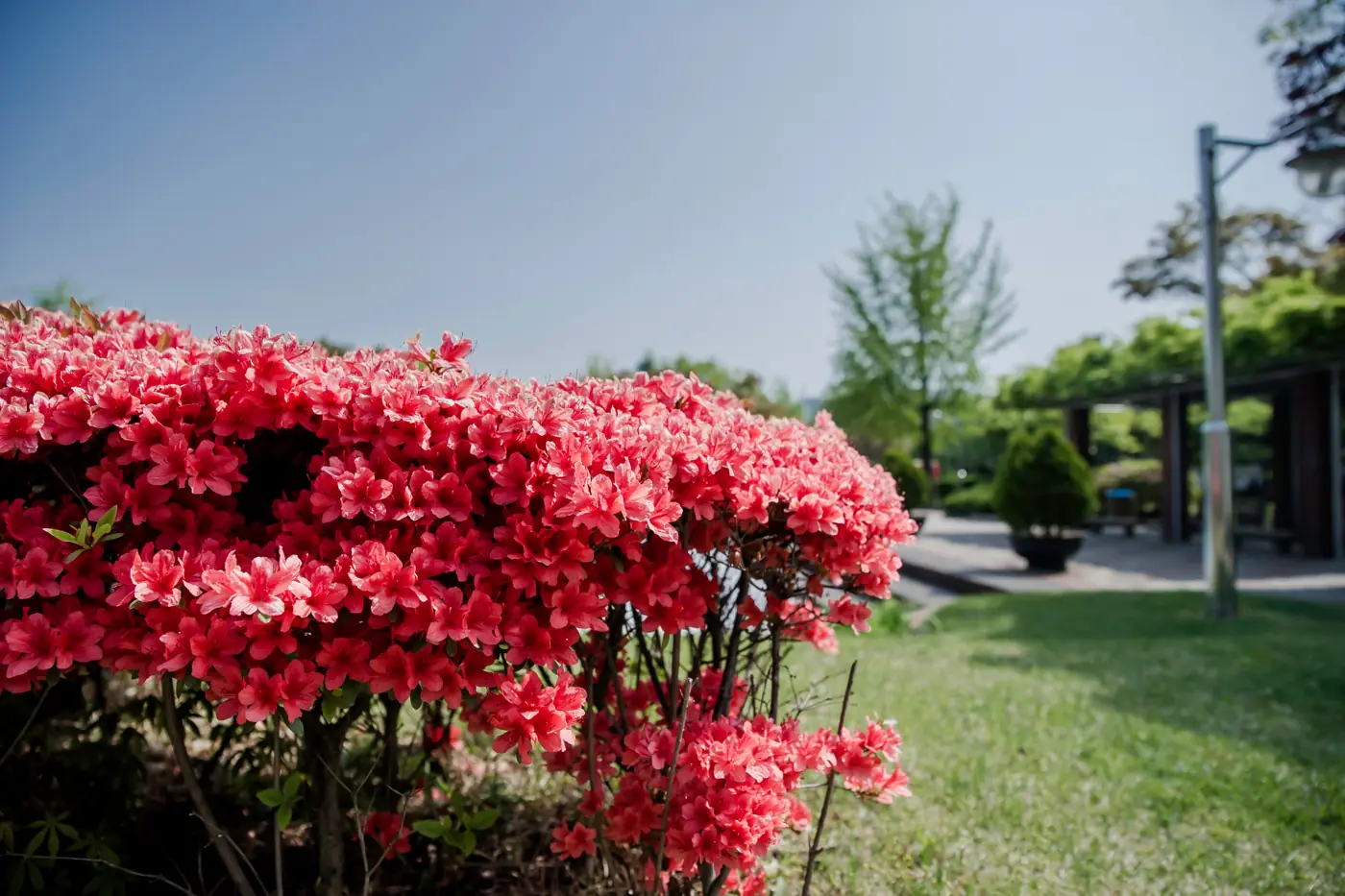
What is an azalea and how is it different from a rhododendron?
Every azalea is a rhododendron, but not every rhododendron is an azalea. Both belong to the plant genus Rhododendron, so you will often see labels saying azalea rhododendron or rhododendron azalea. The difference is mostly about size and leaf habit. Azaleas tend to be smaller, with thinner, more delicate leaves, and they usually carry clusters of five-stamen flowers. Rhododendrons are typically larger, with thicker, leathery leaves and ten or more stamens per flower.
Evergreen Japanese azaleas usually have smaller leaves and a lower, denser growth habit than the large-flowered rhododendrons commonly grown in UK gardens. Deciduous azaleas can grow considerably taller and shed their leaves in autumn. Leaf size and growth habit provide useful clues, although neither is a definitive botanical distinction. Both need the same acid-soil conditions, so you can grow them side by side in a woodland border or a row of large pots on a patio.
Which types of azalea grow best in UK gardens?
There are two main groups that suit British gardens: evergreen azaleas, often called Japanese azaleas, and deciduous azaleas. Evergreen types keep their leaves all year and form neat, low mounds. They are the ones you see in small town gardens, rockeries and pots, where their compact shape works beautifully. Deciduous azaleas lose their leaves in autumn, but before they do, the foliage often turns rich orange, red or purple. Their flowers tend to be larger and more trumpet-shaped, and many are intensely fragrant.
Dwarf evergreen azaleas are useful where planting space is limited. Many mature at around 20 cm to 60 cm tall, although their eventual size varies by cultivar. Their low, branching growth suits patio pots, troughs and the front of borders. Japanese azaleas offer flowers in white, pink, red and purple, with some cultivars producing bicoloured blooms. Deciduous types include the native-like azalea pontica (Rhododendron luteum), which carries bright yellow, sweetly scented flowers in May and lights up a dappled woodland edge.
| Type | Leaf habit | Typical height and spread | Flower time | Best for |
|---|---|---|---|---|
| Evergreen (Japanese) azalea | Small, glossy leaves all year | 30 cm to 1 m | April to May | Pots, rockeries, low hedges, front of borders |
| Deciduous azalea | Larger leaves, drops in autumn | 1.2 m to 2.5 m | May to June | Woodland gardens, mixed borders, fragrance |
| Dwarf evergreen azalea | Tiny leaves, dense mound | 20 cm to 60 cm | April to May | Containers, troughs, small gardens |
Where do azaleas grow best?
Azaleas grow best in a spot that mimics a woodland edge: bright but not baked, sheltered but not stuffy. In the UK, that usually means a position with morning sun and light afternoon shade, or dappled light under tall, deciduous trees. A north-facing or east-facing border works well because it avoids the fiercest midday sun. If you garden on the coast, choose a spot protected from salt-laden winds, which can scorch the leaves.
Soil acidity matters as much as position. Azaleas grow best at a pH of around 4.5 to 6.0. Chalky or limestone soils are generally unsuitable for planting directly into the ground, making containers filled with ericaceous compost a more reliable choice. Heavy clay is a separate drainage problem: naturally acidic clay may be suitable if its structure and drainage are improved. On neutral soil, pots make it easier to maintain the conditions azaleas need. In a new-build plot with compacted subsoil, a raised bed filled with ericaceous compost and leaf mould is a good halfway house. Whatever the situation, avoid frost pockets and places where cold, drying wind funnels between buildings.
- Light: dappled shade or morning sun only
- Soil: acid (pH 4.5 to 6.0), moisture-retentive but free-draining
- Shelter: from cold north and east winds
- Avoid: waterlogged clay, chalky soil, deep shade, hot south-facing walls
Shop the plants in this guide
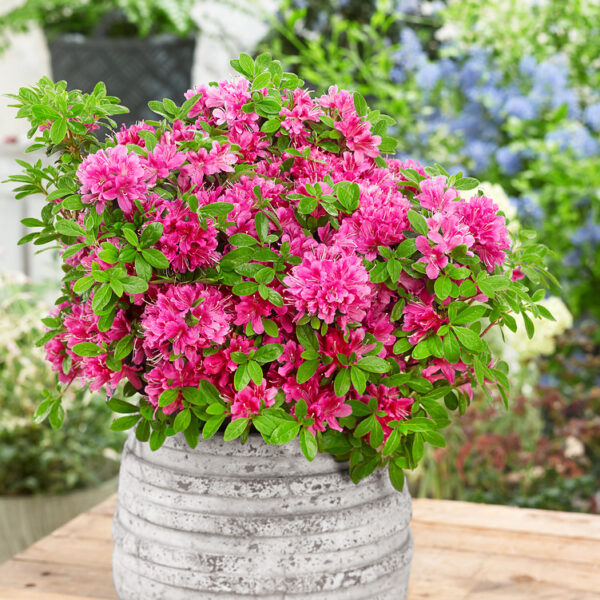
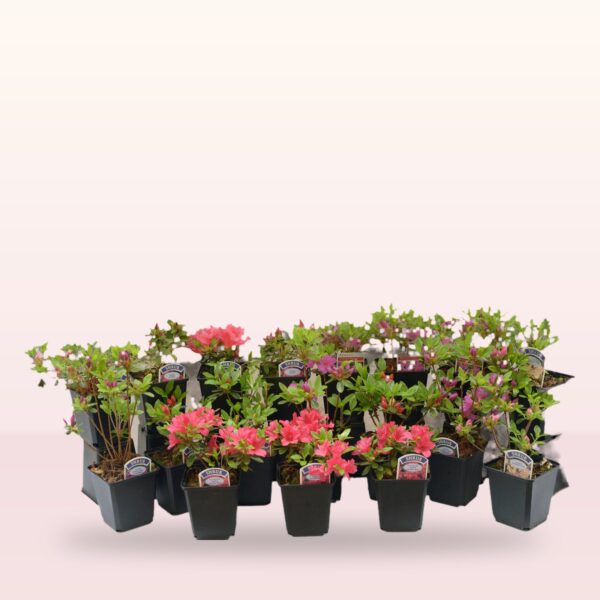
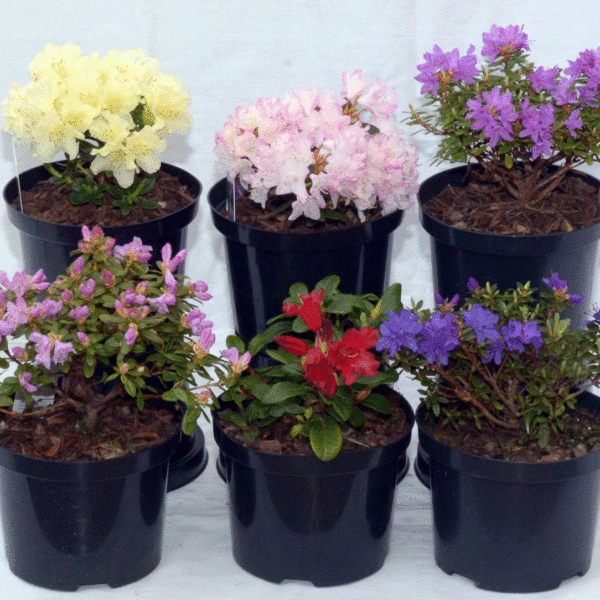
Dwarf evergreen azaleas are available as individual plants in 2 litre pots, with single-colour options for patio containers and the front of borders. Mixed Japanese azaleas are available in 9cm pots in packs of 4 plants, or in 2 litre pots in packs of 4 or 6 plants. Grouping several plants gives a varied spring display, while closer spacing can create a low, informal flowering hedge.
Are azaleas better in pots or ground?
There is no single right answer; it depends on your soil. If you have naturally acid, humus-rich soil, azaleas will settle into the ground happily and need less watering once established. If your soil is neutral to alkaline, or heavy clay that puddles in winter, pots are the better choice. In a family garden with a mix of paving and planting beds, pots let you move the plants around to enjoy the flowers when they are at their peak.
Pots also suit dwarf azalea plants perfectly. A 30 cm to 40 cm wide container gives the roots room to spread without holding too much wet compost. Always use ericaceous compost and a pot with good drainage holes. Stand the pot on feet or gravel so water never sits in the saucer. In the ground, improve the planting hole with plenty of ericaceous compost and leaf mould, and mulch annually with pine bark or bracken to keep the soil cool and acid.
What is the best month to plant azaleas?
You can plant container-grown azaleas at any time of year, but the best months are September to October or March to April. Autumn planting gives the roots a chance to settle while the soil is still warm and damp, so the shrub gets ahead before spring flowering. Spring planting works well too, as long as you water regularly through the first summer. Avoid planting when the ground is frozen, waterlogged or baking dry.
If you buy azaleas for sale in flower during April or May, you can plant them straight away. Just take extra care with watering for the first few weeks, because the plant is putting energy into flowers and new roots at the same time. A liquid ericaceous feed every fortnight through spring and early summer helps it through that busy period.
How to plant an azalea step by step
Planting an azalea is straightforward, but the details matter. The roots are shallow and fibrous, so they need a wide, not deep, planting hole. If you are planting in the ground, test your soil pH first with a simple kit from the garden centre. If the reading is above 6.5, switch to a pot.
Use the following planting method for individual shrubs or groups of dwarf evergreen azaleas. Leave enough room between plants for their mature spread.
- Water the plant thoroughly in its pot an hour before planting.
- Dig a hole twice as wide as the rootball and the same depth. In heavy soil, fork the base to loosen it.
- On naturally acidic soil, mix some leaf mould or composted bark into the excavated earth. Avoid creating a pocket of compost in poorly drained clay, and do not rely on a handful of grit to improve drainage. Use a raised planting area or container if water collects in the hole.
- Tease out the roots gently, especially if they are circling the pot.
- Place the plant in the hole so the top of the rootball sits level with the soil surface. Azaleas hate being planted deep.
- Backfill with the soil-compost mix, firming lightly with your hands.
- Water thoroughly, preferably with rainwater. Standing tap water does not remove the dissolved minerals responsible for hardness.
- Mulch with a 5 cm layer of pine bark, leaf mould or bracken, keeping the mulch away from the stem.
How far apart should I plant azaleas?
Spacing depends on the variety and the look you want. For a low, informal hedge of dwarf evergreen azaleas, plant them closer together so the foliage knits into a continuous ribbon of green. In a mixed border, give each plant more room so its natural mound shape shows. The table below gives a practical guide for the most common types.
If you are planting in pots, one dwarf azalea per 30 cm to 40 cm container is enough. For a larger display, use a wide, shallow bowl planter and space three plants evenly around the edge, leaving the centre free for a small fern or spring bulbs.
| Azalea type | Spacing for a dense group or hedge | Spacing for individual specimens |
|---|---|---|
| Dwarf evergreen azalea | 25 cm to 35 cm apart | 40 cm to 50 cm apart |
| Evergreen (Japanese) azalea | 35 cm to 50 cm apart | 50 cm to 70 cm apart |
| Deciduous azalea | 80 cm to 1.2 m apart | 1.2 m to 1.8 m apart |
How should I water and feed azaleas?
Azaleas have fine, shallow roots that dry out quickly, so consistent moisture is the secret to healthy growth. In the ground, water deeply once or twice a week during dry spells, rather than little and often. In pots, check the compost daily in summer; if the top 2 cm feels dry, water until it runs out of the drainage holes.
Repeated watering with hard tap water can gradually raise the pH of ericaceous compost, making iron less available to azalea roots. Rainwater collected in a water butt is preferable. Use tap water when necessary rather than allowing the plant to dry out, but remember that leaving it overnight does not remove the minerals that cause hardness. An ericaceous fertiliser supplies nutrients but should not be relied upon to correct persistently alkaline growing conditions.
Feeding is simple. Apply a granular ericaceous fertiliser in early March, just as the new growth starts. Scatter it around the root zone, not against the stem, and water it in. Follow up with a liquid ericaceous feed every two weeks from April to July. Stop feeding by August so any soft new growth has time to harden before winter. An annual mulch of leaf mould or pine bark in spring tops up the organic matter and slowly releases nutrients.
- Water: rainwater preferred; keep soil or compost evenly moist, not soggy.
- Feed: granular ericaceous feed in March, then liquid feed fortnightly April to July.
- Mulch: 5 cm of pine bark or leaf mould each spring, away from the stem.
When and how should I prune azaleas?
The golden rule with azaleas is to prune lightly and only when needed. They flower on the previous year's wood, so if you cut them at the wrong time, you remove the next spring's display. The safest window is right after flowering, usually late May or early June. At that point, you can trim back any straggly shoots, deadhead spent flowers if you have the patience, and shape the plant a little.
For evergreen Japanese azaleas, a light clip with shears keeps them dense and neat. Take off no more than a few centimetres of growth. Deciduous azaleas rarely need pruning beyond removing dead, damaged or crossing branches. If an old, leggy azalea has grown too large, you can renovate it by cutting one or two of the oldest stems back to the base each year over three years. That gradual approach is less of a shock than a hard chop.
The table below gives a month-by-month reminder of what to do and what to avoid.
| Month | Pruning task |
|---|---|
| January to February | No pruning. Enjoy the fat flower buds. |
| March | Remove any winter-damaged or dead branches. |
| April to May | Enjoy the flowers. No pruning. |
| Late May to June | Lightly trim evergreen azaleas after flowering. Deadhead if you wish. |
| July to August | No pruning. New flower buds are forming for next year. |
| September to December | No pruning. Leave the plant to rest. |
What are the common problems with azaleas and how do I fix them?
Most azalea problems stem from the wrong soil, too much sun or erratic watering. The good news is that once you get the conditions right, they are largely trouble-free.
Yellow leaves with green veins usually signal lime-induced chlorosis. The soil or compost is too alkaline, so the plant cannot take up iron. Water with a chelated iron solution and switch to rainwater. In pots, repot into fresh ericaceous compost. In the ground, mulch with pine bark and feed with an ericaceous fertiliser, but accept that on chalky soil, pots are the long-term answer.
Brown, scorched leaf edges often mean the plant is in too much hot sun or exposed to drying wind. Move potted plants to a shadier spot. In the ground, create a windbreak with a temporary screen or plant a low hedge of something tough like lavender in front to filter the breeze.
Few or no flowers is nearly always caused by pruning at the wrong time, or by a late frost zapping the buds. Protect early-flowering varieties with a double layer of horticultural fleece if a hard frost is forecast while buds are swelling. And remember to prune only in the weeks right after flowering.
Azalea gall is a curious fungal disease that turns leaves and flowers into pale, fleshy, swollen blobs. It is more common in wet springs. Pick off any affected parts as soon as you see them and bin them; do not compost. The plant usually grows out of it as the weather dries.
- Yellow leaves with green veins: treat for lime-induced chlorosis with chelated iron and rainwater.
- Scorched leaf edges: move to a shadier, sheltered spot.
- No flowers: check pruning time; protect buds from late frost with fleece.
- Azalea gall: pick off swollen, pale growths and bin them.
Are azaleas poisonous to people and pets?
Yes, all parts of the azalea plant are toxic if eaten. The leaves, flowers and nectar contain grayanotoxins, which can cause nausea, vomiting, drooling, low blood pressure and, in severe cases, heart problems. The risk is real for cats, dogs, rabbits and grazing animals, as well as for young children who might put flowers or leaves in their mouths.
In a family garden, the practical solution is to plant azaleas where they can be enjoyed without being nibbled. Pots on a raised stand, hanging baskets (for dwarf types), or a fenced-off front garden bed all work well. Teach children not to eat any part of a garden plant, and if you suspect your pet has chewed an azalea, contact your vet straight away. When pruning, wear gloves and wash your hands afterwards, because the sap can irritate skin.
How can I use azaleas in my garden design?
Azaleas are brilliant team players. Their neat shape and long flowering season make them one of the most useful shrubs for spring colour. Here are a few ideas that work in real UK gardens.
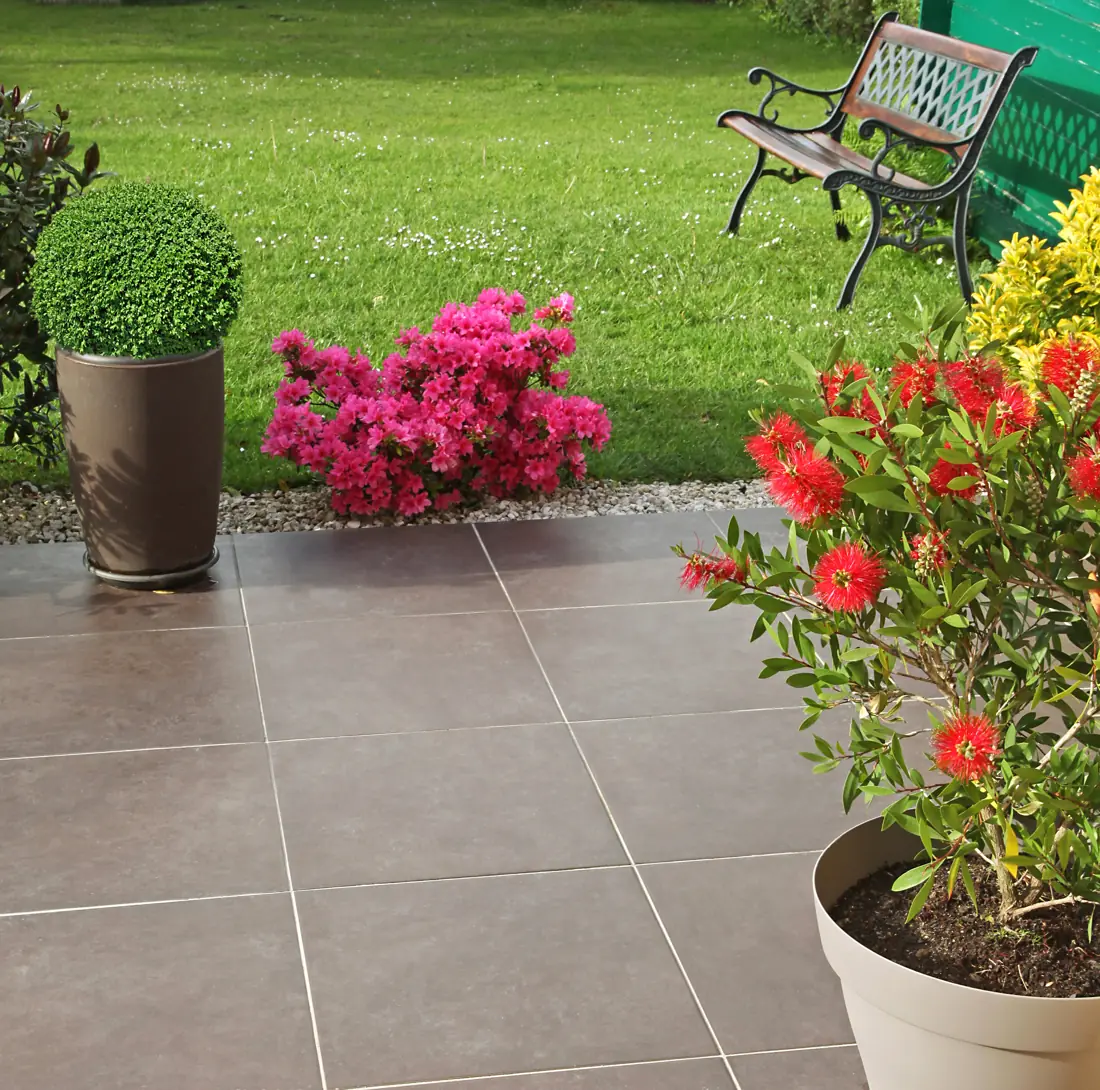
For a small front garden, plant a row of dwarf evergreen azaleas along the path to the door. Underplant with blue grape hyacinths or white anemones for a crisp, cheerful welcome from April onwards. In a back garden with a patio, group three different-coloured Japanese azaleas in glazed pots. Move them to centre stage when they are in flower, then tuck them into a side border for the rest of the year.
In a woodland garden, dot deciduous azaleas among ferns, hostas and hellebores. The azalea pontica (Rhododendron luteum) with its yellow, fragrant flowers looks wonderful against a backdrop of dark yew or holly. If you have a new-build plot with a bare fence, plant a mixed hedge of evergreen azaleas and pieris. Both love acid soil and give you a long season of colour, from pieris' red new growth in spring to the azalea flowers that follow.
For a wildlife-friendly garden, single-flowered azaleas offer pollen and nectar for early bumblebees. Avoid double-flowered varieties if pollinators are a priority, because the extra petals can block access to the centre of the flower.
What should I look for when buying azalea plants?
When choosing azalea plants, look for firm, healthy foliage and a well-branched shape. Flower buds are useful to see in season, although their absence is normal at certain times of year. Check the stems and leaf undersides for pests, including scale insects, and avoid plants with extensive unexplained browning or dieback. A 2 litre pot indicates the container volume rather than a guaranteed plant height, so assess the branching and root condition as well as the pot size.
Think about the mature size as well as the flower colour. A dwarf azalea in a 9 cm pot will take a few years to reach its full spread, but it will never outgrow a small space. If you want instant impact in a border, go for a larger pot size. For a low hedge or a mass planting, smaller pots are more economical and will catch up quickly with good care.
Common questions
Are azaleas better in pots or ground?
It depends on your soil. If you have acid, well-drained soil, azaleas thrive in the ground. On chalky, clay or neutral soil, pots of ericaceous compost give you full control and are the safer choice. Pots also suit dwarf varieties and small gardens.
What are the disadvantages of azaleas?
Azaleas need acid soil or ericaceous compost, so they will not grow in ordinary garden soil if it is alkaline. They are toxic if eaten, so care is needed around pets and children. They also need regular watering in dry weather and shelter from cold, drying winds.
Where do azaleas grow best?
Azaleas grow best in dappled shade or morning sun with shelter from cold wind and hot afternoon sun. They need acid, moisture-retentive but free-draining soil. A woodland-edge position or a sheltered courtyard with pots works well.
What is the best month to plant azaleas?
The best months are September to October or March to April. Autumn planting lets roots establish before winter, while spring planting is fine if you water regularly through the first summer. Avoid frozen, waterlogged or parched ground.
How often should I water azaleas in pots?
Check the compost daily in summer. If the top 2 cm feels dry, water thoroughly with rainwater until it runs out of the drainage holes. In winter, water only when the compost is dry to the touch, which might be once every week or two.
Can I grow azaleas indoors?
The garden azaleas sold for outdoor planting are not suited to living indoors long-term. They need a cool, humid, well-lit spot and a winter chill to set flower buds. Indoor 'florist' azaleas are a different, tender type and need different care.
Why are the leaves on my azalea turning yellow?
Yellow leaves with green veins usually mean the soil or compost is too alkaline, causing iron deficiency. Water with rainwater and a chelated iron solution. In pots, repot into fresh ericaceous compost. In the ground, mulch with pine bark and feed with ericaceous fertiliser.
Do azaleas lose their leaves in winter?
Evergreen Japanese azaleas keep their leaves all year, though some may take on a bronze or reddish tint in cold weather. Deciduous azaleas drop their leaves in autumn, often after a show of bright leaf colour.
How long do azalea flowers last?
Most azaleas flower for two to four weeks, depending on the weather. Cool, still conditions prolong the display; hot sun and wind shorten it. Planting in light shade helps the flowers last longer.
Can I plant azaleas next to a hedge?
Yes, as long as the hedge does not cast deep shade or suck moisture from the soil. A north-facing hedge can provide useful shelter. Avoid planting too close to vigorous conifer hedges like Leylandii, which create dry, shaded conditions that azaleas dislike.