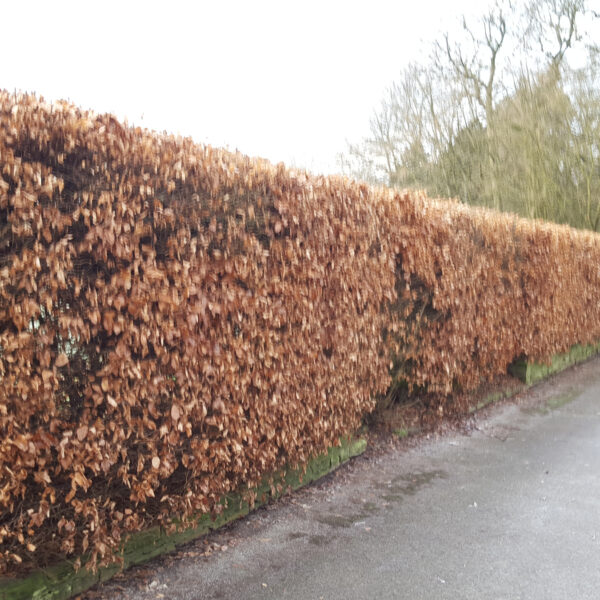
Beech hedge plants for year-round structure and wildlife value
Green beech (Fagus sylvatica) makes a fine boundary hedge, with fresh green leaves in spring that turn golden, then copper brown in autumn. Although deciduous, a regularly clipped beech hedge usually retains much of its dry foliage through winter, giving some shelter and screening until the new leaves appear. Our green beech hedging plants are supplied individually at 90 to 120cm tall. Plant them in a single row for a neat garden boundary or a staggered double row where you have room for a thicker hedge. The dense branches also provide useful cover for garden birds.
Beech hedging plants: what we sell
Our green beech hedging is available as individual 90 to 120cm plants. The catalogue does not specify a pot size or root type for this product, so check the product details before planning your planting. At this starting height, the plants already have stems that can be encouraged to branch through regular formative trimming. Their eventual height and density will depend on spacing, growing conditions and how carefully they are maintained.
Each green beech hedging option contains one plant, so work out the quantity from your boundary length and preferred spacing. The table below gives planting quantities for single and staggered double rows. Measure the planting run carefully, allowing for gates, paths and corners before calculating your total. You may also want a few spare plants to fill any gaps later.
Green beech: why does it keep its brown leaves in winter?
Green beech is deciduous, but young beech hedges and clipped plants hold onto their dead leaves through autumn and winter, a habit called marcescence. The crisp, copper brown foliage stays on the twigs until new green buds push it off in spring. This gives you a soft, rustling screen when most other deciduous hedges are bare.
Marcescence is most noticeable on young growth and regularly clipped hedges. Leaf retention varies with age, exposure and winter weather, so some branches may become bare before spring. The foliage changes from fresh green to yellow and copper brown in autumn, with the remaining dry leaves giving the hedge colour and partial screening during the colder months.
How many beech plants do I need per metre?
Planting distances depend on the size of the plants you start with and how quickly you want a solid hedge. For our 90 to 120cm pot grown beech, a single row spaced 30 to 40cm apart works well for a hedge that fills out steadily. If you want faster density, plant a staggered double row with 40 to 50cm between plants in each row and 30 to 40cm between the two rows.
Use the table below to calculate how many plants to order for common hedge lengths. Always round up to the nearest whole plant.
| Hedge length | Single row (3 plants per metre) | Double row (5 plants per metre) |
|---|---|---|
| 5 metres | 15 plants | 25 plants |
| 10 metres | 30 plants | 50 plants |
| 20 metres | 60 plants | 100 plants |
When is the best time to plant a beech hedge?
Pot grown beech hedging plants can go into the ground whenever the soil is not frozen or waterlogged. That said, early autumn (September to October) and mid spring (March to April) are ideal. The soil is warm and moist at these times, which helps roots settle in before the plant faces summer heat or winter cold.
If you plant during summer, water thoroughly every few days for the first month and mulch around the base to hold moisture. Avoid planting on frosty days or when the ground is baked hard. Beech roots hate sitting in wet soil, so if your garden has heavy clay, dig in some grit or well rotted compost before planting.
How fast does a beech hedge grow and how tall will it get?
Once established, green beech puts on roughly 30 to 60cm of growth a year, depending on soil, light and moisture. Left untrimmed, a beech tree can eventually top 25 metres, but as a hedge it is usually kept between 1.2 and 3 metres. Most home gardeners trim annually to maintain a neat shape at 1.5 to 2 metres, which is a comfortable height for privacy without casting too much shade.
Starting with 90 to 120cm plants gives you useful initial height, but reaching 1.5 metres may take several growing seasons depending on planting conditions and pruning. Water regularly during the first summer and give a light spring feed if the soil is poor. Beech grows more slowly in very dry or shallow soil, particularly where young roots face competition from established trees.
How do I feed a beech hedge?
Beech is not a hungry plant, but a little feeding keeps the foliage rich green and the growth steady. In early spring, sprinkle a handful of general purpose granular fertiliser, such as fish, blood and bone, along the base of the hedge and water it in. A 5cm mulch of garden compost or leaf mould laid over the root zone after feeding helps lock in moisture and slowly releases nutrients.
Avoid high nitrogen lawn feeds, which push soft, sappy growth that can scorch in summer. If leaves look pale or yellow between the veins, the soil may be too alkaline, locking up iron. In that case, a dose of sequestered iron or an ericaceous tonic can green them up again.
When and how should I trim a beech hedge?
Trim a beech hedge once or twice a year to keep it dense and tidy. The main cut is best done in late summer, from late July to August, after the spring growth has hardened off. By late summer, the main flush of growth has usually matured, making it easier to achieve an even outline. A lighter tidy-up can be done in early February if needed. Always check carefully for active birds' nests before cutting, including during August, and postpone any work that could damage or disturb an occupied nest.
Use sharp shears or a hedge trimmer and cut back the current season's growth to a couple of buds from the older wood. Taper the sides so the hedge is slightly wider at the base than the top, which lets light reach the lower branches and stops the bottom thinning out. For a deeper guide, read our full article on trimming a beech hedge.
Common beech hedge problems and how to solve them
Beech hedges are generally tough, but a few issues can show up. Aphids sometimes cluster on soft new leaves in spring, causing them to curl. A strong jet of water from the hose often shifts them, or you can use a soft soap spray. Woolly beech aphid leaves a conspicuous white, cottony coating on the undersides of leaves, sometimes causing curling or browning. Established hedges usually tolerate light infestations without treatment.
Powdery mildew can appear as a white dusting on leaves in dry summers when the hedge is stressed. Water the roots deeply during dry spells and thin out any congested growth to improve airflow. Beech bark disease, caused by a scale insect and a fungus, is less common but can kill branches. Prune out affected wood and burn or bin it. Leaf yellowing is usually a sign of waterlogged roots or iron deficiency on chalky soil, so check drainage before you feed.
Expert tip: get your beech hedge off to a flying start
The first growing season is particularly important for root establishment. For a long, closely spaced hedge, a continuous planting trench makes it easier to prepare the soil evenly and position the plants at consistent intervals. Make the trench 40 to 50cm wide and a spade's depth, loosen the bottom with a fork, then mix the dug soil with a bucket of garden compost per metre run. Set each plant at the same depth it was in its pot, firm the soil gently, and water with a full watering can per plant. A 5cm mulch of bark or compost over the whole trench keeps weeds down and moisture in, and it makes the first season's aftercare much simpler.
- Dig a trench 40 to 50cm wide and a spade deep
- Loosen the base with a fork and mix in garden compost
- Plant at the same depth as the pot, firm in and water well
- Mulch the whole trench with 5cm of bark or compost
Questions before you order
Is beech hedging evergreen?
No, beech is deciduous. However, clipped hedges often retain many of their copper-brown autumn leaves through winter, a habit called marcescence. These leaves provide some screening until the new foliage emerges in spring. Retention varies between plants and with winter weather, so beech should not be treated as a fully evergreen privacy screen.
Can I plant a beech hedge in shade?
Green beech grows well in partial shade, though it will be less dense and grow more slowly than in full sun. Avoid deep shade under large evergreen trees, where the soil is often dry and starved of light. A spot that gets morning sun or dappled light for part of the day is fine.
How deep should I plant beech hedging?
Plant pot grown beech at the same depth it was in the nursery pot. Look for the soil mark on the stem and make sure it sits level with the surrounding soil after planting. Planting too deep can rot the stem, while planting too shallow exposes the roots.
Is beech hedging safe for pets and livestock?
Beech leaves and nuts are not considered seriously toxic, but eating large quantities of any unfamiliar plant material can upset a dog or cat's stomach. Beech nuts (mast) can be a choking hazard for dogs if swallowed whole. If you keep horses or cattle, beech is generally safe, but always check with your vet for specific grazing advice.
Can I grow a beech hedge in a pot or raised bed?
Beech is a large, deep rooting tree and is not suited to long term life in a pot. A row of beech in a deep, wide raised bed (at least 60cm deep and wide) can work for a few years as a temporary screen, but the plants will eventually need more root space than a container can offer.
When will my new beech hedge join up into a solid screen?
Planted at 30 to 40cm spacing with our 90 to 120cm plants, a beech hedge usually knits together into a continuous screen within two to three full growing seasons. Watering well in the first summer and feeding lightly each spring speeds up the process. A double staggered row gives a solid screen a year or so sooner than a single row.