Lavender hedge at a glance
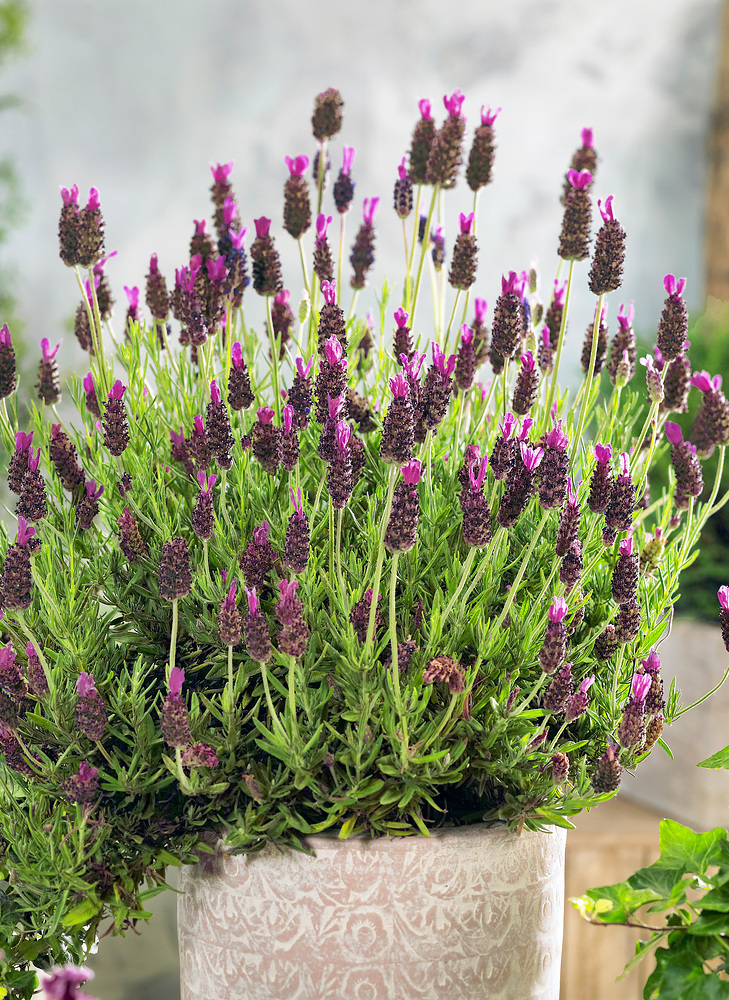
A low lavender hedge works well beside a sunny path, along the front of a border or around a patio. Planted in a single row, the bushes gradually meet to form a soft edge, with aromatic foliage and purple flowers that attract pollinating insects. French lavender has distinctive flower heads topped with upright, petal-like bracts, giving it a different appearance from the longer flower spikes of English lavender.
You can create a lavender hedge in a small town garden, a family garden where children play, or even in a long trough on a balcony. For a tidy hedge, allow enough room between plants for air to circulate, provide sharp drainage and trim the soft growth regularly. French lavender needs particular care in winter because it is less tolerant of prolonged frost and wet soil than English lavender.
Our French lavender Bandera Purple (Lavandula stoechas) is supplied in 1 litre pots, available as single plants or packs of 2 or 4. It is a compact variety with deep purple flower heads and tufted bracts. Depending on planting time and growing conditions, plants may flower during their first growing season, although a fuller hedge takes longer to develop. French lavender is less hardy than English lavender, so it suits milder gardens and sheltered spots. If your garden is very cold or exposed, English lavender (Lavandula angustifolia) is the hardier choice for a lavender hedge, but we do not stock it.
Which lavender makes the best low hedge?
For a low, compact lavender hedge, French lavender and English lavender are the two main options. French lavender (Lavandula stoechas) has distinctive tufted flowers on short spikes and blooms from late spring through summer, often with a second flush in early autumn. It grows to about 40 to 60cm tall and wide, making it a neat choice for edging paths and borders.
English lavender (Lavandula angustifolia) is hardier, coping with temperatures down to around -15°C, and its slender flower stems rise above the foliage to 60 to 90cm. It is the traditional choice for a lavender hedge in colder parts of the UK. French lavender Bandera Purple is the variety available from our range, in 1 litre pots as individual plants or packs of 2 or 4. The comparison with English lavender is useful when deciding whether French lavender will cope with your garden's winters, particularly in exposed or northern locations.
French vs English lavender for hedging
Gardeners often ask whether French or English lavender is better for a hedge. The answer depends on your garden’s winter temperatures and the look you want. French lavender flowers earlier and has those eye-catching butterfly-like bracts at the top of each flower head. English lavender is hardier and its flowers are more traditional, held on longer stems that sway in the breeze.
The table below compares the two lavenders for hedging, so you can match the plant to your plot.
| Feature | French lavender (Lavandula stoechas) | English lavender (Lavandula angustifolia) |
|---|---|---|
| Hardiness | H4 (down to about -5°C to -10°C) | H5 (down to about -10°C to -15°C) |
| Typical hedge height | 40 to 60cm | 60 to 90cm |
| Flower shape | Short spikes with tufted bracts on top | Long, slender spikes without tufts |
| Main flowering period | Late spring to late summer, often repeat flowering | Mid to late summer |
| Scent | Strong, slightly camphor-like | Sweet, classic lavender fragrance |
| Best for | Milder gardens, sheltered patios, pots | Colder gardens, exposed sites, traditional cottage hedges |
Spacing per metre for a lavender hedge
For a single row of French lavender Bandera Purple, allow around three plants per metre. The plants can spread to approximately 40 to 50cm across in suitable conditions, so this spacing gives neighbouring bushes room to meet without crowding. Keep the line straight with a string and measure between the centres of the rootballs rather than between the edges of the pots. That gives you a spacing of roughly 33cm between each plant, measured from the centre of one root ball to the next.
If you want a slightly denser hedge faster, you can plant four plants per metre (about 25cm apart), but French lavender needs good air circulation to avoid grey mould in wet summers, so do not cram them too tightly. For a double staggered row, use five plants per metre, setting the second row 20 to 25cm behind the first and offsetting the plants like the dots on a dice.
At three plants per metre, you can calculate the number needed by multiplying the hedge length by three. For example, a 5 metre hedge requires 15 plants, while a 10 metre hedge takes 30. French lavender Bandera Purple is available in 1 litre pots as single plants or packs of 2 or 4, so you can combine pack sizes to reach your planting total.
list
- For a 5 metre lavender hedge: 15 plants (single row at 3 per metre)
- For a 10 metre lavender hedge: 30 plants (single row at 3 per metre)
- For a 20 metre lavender hedge: 60 plants (single row at 3 per metre)
Planting and soil for a lavender hedge
Lavender grows naturally in sunny, well-drained Mediterranean habitats and dislikes having its roots in wet soil for long periods. Choose the sunniest part of the garden and check how quickly the ground drains after rain. On heavy clay, adding a little grit to an isolated planting trench may not be enough because water can still collect around the roots. A broader, raised planting area, around 10 to 15cm above the surrounding ground, can help where drainage is poor. Use a suitable free-draining soil mix throughout the raised area.
Plant your lavender hedge in spring, from March to May, so the roots establish before winter. You can also plant in early autumn, from September to early October, as long as the soil is still warm. Avoid planting in frozen or waterlogged ground.
Follow these steps for the best start:
- Choose a spot that gets at least six hours of direct sun a day.
- Dig a trench about 20cm deep and 30cm wide for a single row.
- Mix a handful of grit into the bottom of the trench if your soil is heavy.
- Space the plants at 33cm intervals (three per metre).
- Set each plant so the top of the root ball is level with the soil surface.
- Backfill gently and firm the soil with your hands, not your feet.
- Water well after planting, then water once a week in dry spells for the first summer.
Pruning to keep it compact
A lavender hedge that is never pruned turns woody, leggy and open at the base within a few years. For French lavender, remove faded flower stems during the flowering season and give the plants their main shaping trim after the principal flush, usually in late summer. In spring, wait until frost damage is clear before removing dead tips or lightly adjusting the shape. Avoid cutting hard into old, woody stems, which may not produce replacement shoots.
For the summer trim, cut back the spent flower stems and about 2 to 3cm of the soft green growth. This tidies the hedge and often encourages a second flush of flowers in early autumn. In spring, cut back a little further, removing about a third of the previous year’s growth, but never cut into old, bare wood. French lavender does not regenerate well from woody stems, so always leave a few centimetres of green growth below your cut.
If your lavender hedge is already leggy, the kindest thing is to replace the worst plants. Replacing individual woody or failing plants with young French lavender Bandera Purple in 1 litre pots can restore an uneven hedge. Allow the new plants time to fill the gaps, and check drainage before replanting if the originals failed during winter. Regular light trimming will help the replacements develop a bushier shape.
Winter care for a French lavender hedge
French lavender is less hardy than English lavender, so winter care matters, especially in a cold or wet garden. In mild areas and sheltered town gardens, a French lavender hedge often sails through winter with no help. In colder spots, or if your soil is heavy and slow to drain, wet winter roots are a bigger threat than frost.
To protect your hedge, avoid mulching right up against the stems, as this traps moisture. A light gravel mulch around the plants helps keep the crowns dry. In very cold snaps, you can throw a double layer of horticultural fleece over the hedge, but remove it as soon as the weather warms up to stop condensation building up.
A month-by-month care calendar helps you stay on track.
| Month | Task |
|---|---|
| January | Check for frost heave and firm any lifted plants back in. |
| February | Plan any replacements for plants that have died back. |
| March | Spring prune: cut back about a third of last year’s growth. |
| April | Plant new lavender hedges as the soil warms up. |
| May | Water new plants in dry spells; watch for early flowers. |
| June | Enjoy the first flush of flowers; deadhead if you wish. |
| July | Water during prolonged dry weather. |
| August | Summer trim after the main flowering; shape the hedge. |
| September | Plant new hedges early in the month if soil is warm. |
| October | Clear fallen leaves from the base to prevent rot. |
| November | Avoid planting in wet or frozen soil. |
| December | Check fleece is secure if a hard frost is forecast. |
Feeding and watering a lavender hedge
Lavender is not a hungry plant. In fact, too much nitrogen from rich compost or fertiliser encourages soft, sappy growth that flops over and is more vulnerable to frost. Lavender usually needs little supplementary feeding in ordinary garden soil. If growth is weak and a nutrient deficiency is suspected, use a suitable low-nitrogen fertiliser sparingly in spring, following the manufacturer's dosage. Avoid applying an unmeasured handful of sulphate of potash, as unnecessary fertiliser can upset nutrient balance and encourage poor growth.
Watering is only needed in the first growing season and during long dry spells. Once established, a lavender hedge is remarkably drought-tolerant. Overwatering, especially in winter, is the quickest way to lose plants to root rot.
Common problems with lavender hedges
Most lavender hedge problems come down to wet soil, shade or pruning mistakes. Yellowing leaves and wilting are often signs of waterlogged roots. If you see this, dig up one plant and check: black, mushy roots mean root rot. Improve drainage or move the hedge to a sunnier, drier spot.
Grey mould (Botrytis) can appear in wet summers, especially if plants are too close together. Thin out any overcrowded stems and make sure air can circulate. Frost damage shows as brown, dead patches at the tips in spring: simply prune these out when you do your spring trim. Lavender is generally pest-free, though rosemary beetle can occasionally nibble the leaves. Pick them off by hand if you spot them.
Can I grow a lavender hedge in pots?
Yes, a miniature lavender hedge in a long trough or a row of matching terracotta pots looks lovely on a sunny patio or balcony. Use a container at least 30cm wide and deep, with plenty of drainage holes. Fill it with a mix of John Innes No. 2 and about a third horticultural grit.
Space the plants about 20 to 25cm apart in the container. Water more often than you would in the ground, but let the compost dry out between waterings. Feed with a half-strength liquid tomato feed once a month from April to August. In winter, move the pot against a sheltered wall and raise it on pot feet to keep the drainage holes clear.
Common questions
How many lavender plants do I need for a hedge?
For a single row of French lavender, plant three per metre, which is about 33cm apart. For a 5 metre hedge you need 15 plants, for 10 metres you need 30, and for 20 metres you need 60. If you want a double staggered row for a thicker hedge, use five plants per metre.
When is the best time to plant a lavender hedge?
Plant a lavender hedge in spring, from March to May, so the roots can settle in before summer. You can also plant in early autumn, in September or early October, while the soil is still warm. Avoid planting in frozen or waterlogged ground over winter.
How do I prune a lavender hedge so it doesn’t go woody?
Prune twice a year. In late summer, after the first flowers fade, trim off the spent stems and about 2 to 3cm of soft growth. In early spring, around March, cut back about a third of last year’s growth, but never cut into old, bare wood. Always leave some green growth below the cut.
Is French lavender hardy enough for a hedge in the UK?
French lavender is hardy down to about -5°C to -10°C, so it does well in milder gardens, sheltered town plots and coastal areas. In colder or more exposed gardens, English lavender is the safer choice for a hedge, as it withstands temperatures down to around -15°C.
What soil does a lavender hedge need?
Lavender needs free-draining soil and full sun. If you have heavy clay, dig in plenty of horticultural grit or coarse sand before planting, and consider raising the planting area slightly. Avoid rich compost or manure, which encourages soft growth that flops and is prone to frost damage.
Can I grow a lavender hedge in a shady garden?
Lavender does not thrive in shade. It needs at least six hours of direct sunlight a day to flower well and stay compact. In a shady garden, a lavender hedge will grow leggy, produce fewer flowers and be more prone to fungal problems. Choose a sunnier spot or consider a shade-tolerant alternative like box or yew.