Rhododendron care at a glance
Rhododendrons grow best with acidic soil, shelter from drying winds and enough moisture to keep their shallow roots from drying out. Most retain their thick, leathery leaves through winter, with clusters of flowers appearing in spring. Give them dappled shade, mulch the roots and remove faded flower heads carefully. Once established, most need very little pruning, making them useful shrubs for sheltered borders and patio containers.
Most rhododendrons are evergreen, holding their leathery leaves through winter, and flower from late March into June depending on the variety. Dwarf types are especially useful in small town gardens, family plots or pots on a patio, where a full-size shrub would feel too bulky. Their shallow roots need particular attention during dry spells, and flower buds can suffer in exposed positions. Choose a sheltered spot with suitable soil and leave the secateurs alone unless the shrub needs shaping.
| Care factor | What rhododendrons need |
|---|---|
| Soil | Acid (pH 4.5 to 6.0), rich in organic matter, free-draining |
| Light | Dappled or partial shade; avoid deep dry shade and hot afternoon sun |
| Watering | Keep soil evenly moist, especially in the first two seasons |
| Feeding | Use a fertiliser for acid-loving plants in early spring |
| Deadheading | Snap off faded flower heads straight after blooming |
| Pruning | Lightly after flowering; harder renovation pruning in late winter or early spring |
| Hardiness | Fully hardy in the UK, but late frosts can damage early blooms |
When do rhododendrons flower?
The main flowering season for rhododendrons in the UK runs from late March through to late June, with the peak in April and May. Exactly when your shrub blooms depends on the variety, how sheltered the spot is and how cold the spring has been. Early types such as Rhododendron ‘Christmas Cheer’ can open in mild winters as early as January, while late-season hybrids keep going into July.
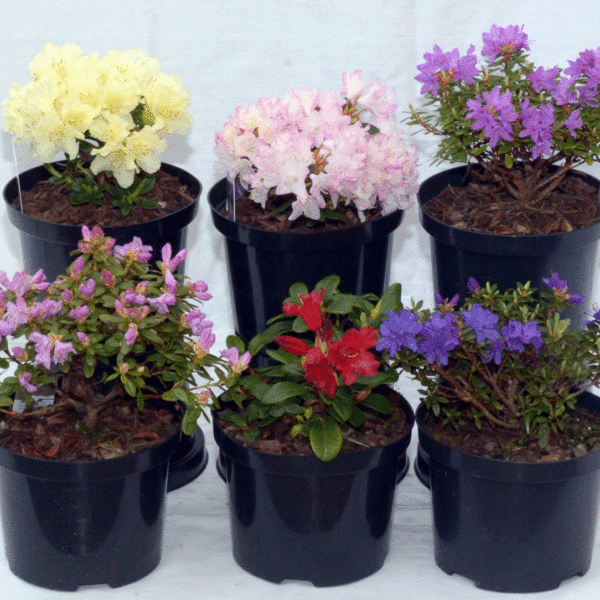
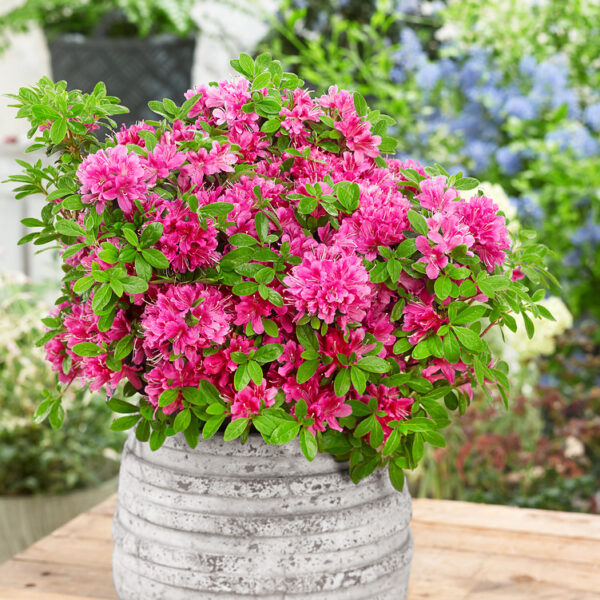
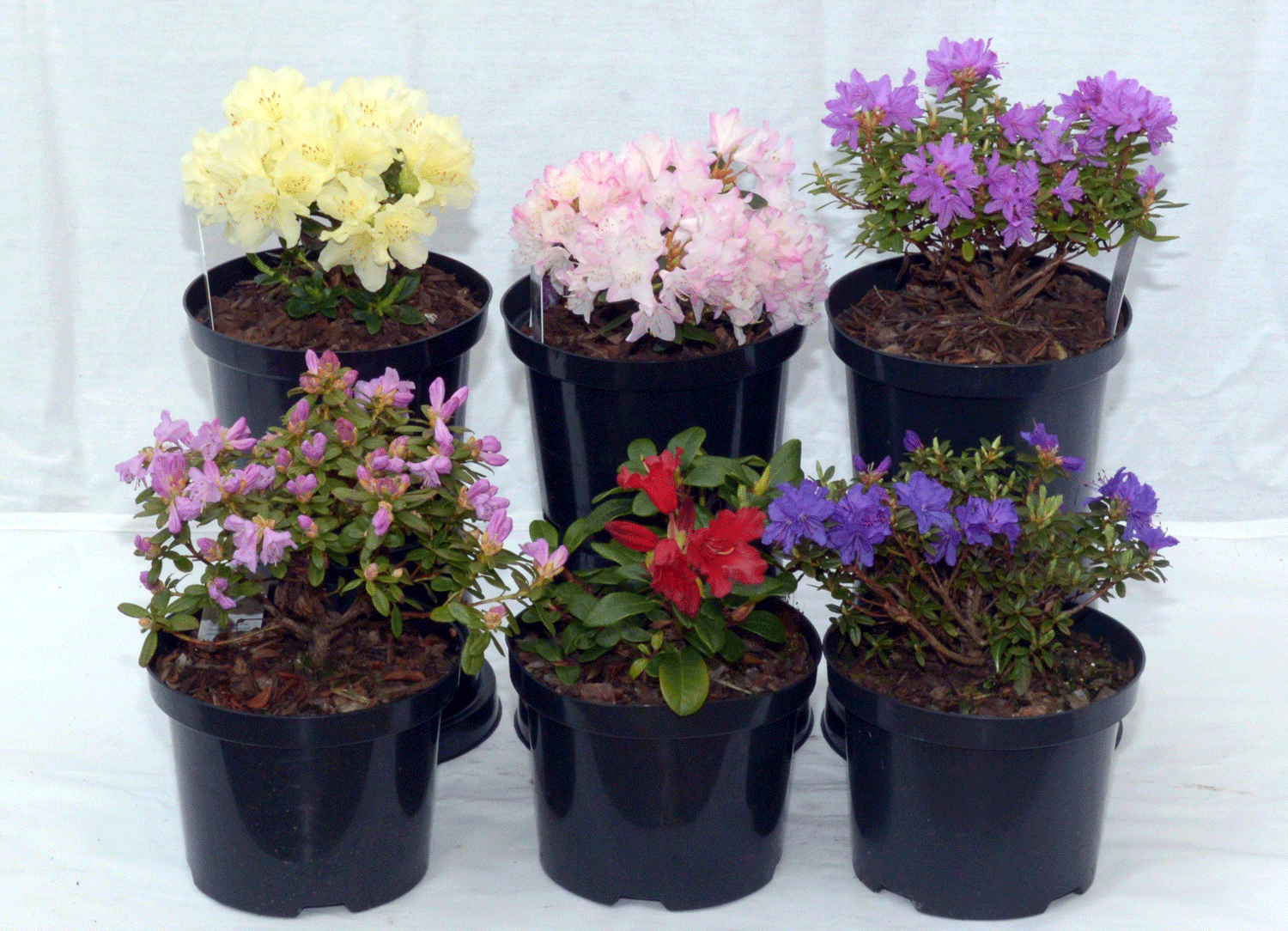
Dwarf rhododendrons and compact hybrids, including the mixed dwarf rhododendrons we offer, typically flower in April and May. They produce dense clusters of bell-shaped blooms in shades of pink, white, red, purple and cream. In a warm, sheltered town garden you might see the first colour a week or two earlier than in an exposed rural plot. A healthy pot-grown shrub may already carry flower buds when planted, so you could see flowers in its first spring. Others take longer to settle and produce a fuller display. Keep the roots evenly moist during establishment, particularly through the summer when next year's buds are developing.
- Early-season rhododendrons: late March to mid-April
- Mid-season rhododendrons: mid-April to late May
- Late-season rhododendrons: late May to late June
- Dwarf and compact hybrids: April to May
- In mild springs, flowering can start up to two weeks earlier
Where to plant rhododendrons: shade, shelter and acid soil
Rhododendrons like dappled or partial shade, the kind you get under the canopy of a light woodland tree or on the east side of a house. They do not like deep, dry shade where the soil stays parched, nor do they enjoy baking afternoon sun, which can scorch their leaves. A spot with morning sun and afternoon shade is ideal. If you are planting in a new-build garden with little shelter, give them a position out of cold, drying winds.
The single most important rule is acid soil. Rhododendrons need a pH between 4.5 and 6.0. On chalk or limestone, grow dwarf rhododendrons in containers filled with ericaceous compost rather than trying to acidify a small planting hole. Heavy clay is not necessarily alkaline, so test its pH and check drainage before deciding. In naturally acidic borders, leaf mould or composted bark can improve soil structure and help retain moisture. RHS Rootgrow is available in 60g packs and 360g packs with gel; if using it, follow the pack instructions and place it where the roots will make contact.
- Light: dappled shade or morning sun with afternoon shade
- Shelter: away from cold north and east winds
- Soil pH: 4.5 to 6.0, tested with a simple kit
- Soil type: rich in organic matter, free-draining but moisture-retentive
- Avoid: chalky or lime-rich soils, waterlogged ground, deep dry shade
Can you grow rhododendrons in pots?
Yes, and dwarf rhododendrons are particularly well suited to container growing. Our mixed dwarf rhododendrons include plants supplied in 2 litre pots, which can be moved into a container around 30 to 40cm wide. Choose a pot with drainage holes and allow enough room for the root system to develop. Check for crowded roots each spring rather than assuming the plant can remain in the same container for several years. Use a pot with plenty of drainage holes and fill it with fresh ericaceous (lime-free) compost. Do not be tempted to use garden soil, which is often too heavy and may not be acid enough.
Potted rhododendrons dry out faster than those in the ground, so check the compost regularly from spring to autumn. Water with rainwater if you can, especially in hard-water areas where tap water can gradually raise the pH. Stand the pot on pot feet or gravel so the drainage holes stay clear. In winter, move the container to a sheltered corner or wrap it in fleece to protect the roots from freezing solid. Feed once in early spring with a liquid feed for acid-loving plants and top-dress with fresh compost every couple of years.
- Choose a pot at least 30cm wide with good drainage
- Use ericaceous compost, never garden soil or multi-purpose
- Water with rainwater where possible to keep pH low
- Raise the pot on feet to prevent waterlogging
- Feed with an acid-plant liquid feed in March or April
- Protect pots from hard frosts with fleece or bubble wrap
How to deadhead and prune rhododendrons
Deadheading is the single most useful job you can do for your rhododendron each year. As soon as the flowers fade, snap off the whole truss at the base with your thumb and forefinger, taking care not to damage the new shoots emerging just below. Removing the spent truss prevents seed development and keeps the shrub tidy. It may also help the plant direct more resources towards new growth, although next spring's flowering still depends on light, moisture and summer growing conditions. On young or small shrubs, deadheading also keeps the shape neat and compact.
Rhododendrons rarely need heavy pruning. If you do need to reduce size or reshape an overgrown shrub, the best time is straight after flowering, while the plant is in active growth. Cut back to a whorl of leaves or a visible growth bud. For an old, leggy rhododendron that has lost its lower leaves, you can carry out renovation pruning in late winter or early spring, cutting branches back to 30 to 60cm from the ground. Some established rhododendrons produce fresh shoots from old wood after hard pruning, but recovery is not guaranteed, especially on weak or stressed plants. Renovate gradually where possible and allow time for regrowth. Avoid autumn pruning because the following spring's flower buds are already forming or fully developed.
- Deadhead: snap off faded flower trusses immediately after blooming
- Light prune: straight after flowering, cut to a leaf whorl or bud
- Renovation prune: late winter to early spring, cut hard back to 30 to 60cm
- Do not prune in autumn: you will cut off next year's flower buds
- Always use clean, sharp secateurs to avoid crushing stems
Why are my rhododendron leaves turning yellow?
Yellow leaves are usually a sign that the plant cannot take up enough iron or magnesium, often because the soil is not acid enough. This is called lime-induced chlorosis. The leaves turn pale yellow between the veins while the veins themselves stay green. Start by checking soil pH and drainage. Sequestered iron can help correct iron deficiency, but an ericaceous mulch alone will not reliably lower the pH of alkaline ground. If the soil is strongly alkaline, moving a dwarf plant into a container of fresh ericaceous compost is usually more effective. Feed only as directed, since excess fertiliser can damage the roots.
Other causes include poor drainage, which leads to root rot, or simply natural leaf drop. Rhododendrons shed some of their oldest inner leaves in late summer, and those leaves turn yellow or reddish before falling. That is normal. If the yellowing is widespread and the plant looks sickly, check the soil moisture first: the ground should feel like a wrung-out sponge, not soggy or bone dry.
- Lime-induced chlorosis: leaves yellow with green veins, soil pH too high
- Poor drainage: yellowing combined with wilting or blackened roots
- Natural leaf drop: older inner leaves yellow and fall in late summer
- Underwatering: leaves turn yellow and crispy at the edges
- Fix: test soil pH, mulch with ericaceous compost, apply sequestered iron
Why is my rhododendron not flowering?
A rhododendron that produces plenty of healthy leaves but no flowers is usually telling you one of three things: it is too young, it was pruned at the wrong time, or it is in too much shade. Young plants often skip a flowering season while they put energy into roots and shoots. If you pruned in late summer, autumn or winter, you probably removed the flower buds that had already formed for the following spring.
Other common reasons include frost damage to buds (a late cold snap can blacken the embryonic flowers), drought stress the previous summer when buds were forming, or too much nitrogen-rich feed, which pushes leafy growth at the expense of blooms. Check that the shrub receives some gentle daylight rather than sitting in deep shade. Water during dry summer spells when flower buds are developing, and use a fertiliser formulated for ericaceous plants if feeding is needed. Avoid heavy applications of nitrogen, which can encourage leafy growth without improving flowering.
- Plant too young: may not flower until its second or third spring
- Wrong pruning time: buds form in summer for the following year
- Frost damage: late spring frosts can kill developing flower buds
- Too much shade: move or thin overhead branches to let in more light
- Overfeeding with nitrogen: use a high-potash feed instead
How and when to feed rhododendrons
Feed rhododendrons once a year in early spring, just as the new growth starts to show. Use a granular fertiliser formulated for acid-loving plants (often labelled for rhododendrons, azaleas and camellias) and scatter it lightly around the root zone, keeping it away from the stem. Water it in well if rain is not forecast. A second light feed after flowering can help support bud formation for the following year, but do not feed after mid-August, as soft late growth is vulnerable to frost.
Mulching is just as important as feeding. Spread a 5 to 8cm layer of ericaceous compost, leaf mould, composted bark or pine needles over the root area each spring. This locks in moisture, suppresses weeds and gently feeds the soil as it breaks down. Keep the mulch a few centimetres away from the main stem to prevent rot. Never use mushroom compost or lime-rich mulches, which will raise the pH.
- Feed: once in early spring with an ericaceous granular fertiliser
- Optional second feed: after flowering, before mid-August
- Mulch: 5 to 8cm of acid organic matter every spring
- Keep mulch clear of the stem to avoid rot
- Avoid: mushroom compost, lime, wood ash or alkaline mulches
Rhododendron care calendar
A simple monthly checklist takes the guesswork out of looking after your shrubs. The busiest months are April to June, when you are deadheading and checking for pests, but most of the year the plant looks after itself as long as the roots stay moist and the mulch is topped up.
| Month | Key tasks |
|---|---|
| January | Check pots for waterlogging; shake snow off branches |
| February | Finish any renovation pruning; test soil pH if needed |
| March | Apply spring feed; top up mulch; plant new shrubs |
| April | Enjoy flowers; start deadheading as blooms fade |
| May | Deadhead regularly; water during dry spells |
| June | Finish deadheading; light prune if needed |
| July | Water deeply in dry weather; check for vine weevil |
| August | Last chance for light feed; keep mulched and watered |
| September | Stop feeding; let growth harden before winter |
| October | Plant new rhododendrons; check drainage around roots |
| November | Mulch if not done in spring; protect pots from frost |
| December | Check ties and stakes; brush off heavy snow |
How to plant a new rhododendron
Planting a rhododendron is straightforward if you prepare the ground well. Dig a hole about twice the width of the pot and the same depth. If your soil is heavy, fork the bottom to loosen it and mix the excavated soil with ericaceous compost or leaf mould. Tease out the roots gently if they are circling the pot, then set the plant so the top of the root ball sits level with the soil surface. Backfill, firm lightly and water thoroughly.
Rhododendrons are shallow-rooted, so never plant them deep. A 5 to 8cm mulch after planting helps settle them in. Space dwarf types about 60 to 90cm apart for a grouped drift; larger varieties need 1.5 to 2.5m depending on eventual spread. The best planting times are spring or early autumn, when the soil is warm and moist. Our mixed dwarf rhododendrons are supplied in 9cm or 2 litre pots, with pack sizes depending on the option selected. They can be planted whenever the ground is workable, although spring and early autumn usually make establishment easier. Avoid planting during frost, waterlogging or prolonged hot, dry weather.
- Dig a hole twice the pot width, same depth
- Mix excavated soil with ericaceous compost
- Set the root ball level with the soil surface, never deeper
- Firm gently, water well, then mulch with 5 to 8cm of acid material
- Space dwarf types 60 to 90cm apart; larger varieties 1.5 to 2.5m
Common questions
When does the rhododendron bloom?
Rhododendrons bloom from late March to late June, with the peak in April and May. Early varieties can flower in March, while late-season types carry on into July. Dwarf hybrids usually flower in April and May. The exact timing depends on the variety, how sheltered the spot is and spring temperatures.
When will rhododendron bloom after planting?
A newly planted rhododendron typically blooms in its second or third spring. In the first year it focuses on root growth. Give it the right conditions: acid soil, partial shade and consistent moisture, and it should flower reliably once established.
When to cut rhododendron?
Light pruning is best done straight after flowering, in late spring or early summer. For hard renovation pruning of overgrown shrubs, cut back in late winter or early spring before new growth starts. Never prune in autumn, as you will remove the following year's flower buds.
How do you deadhead a rhododendron?
Deadhead as soon as the flowers fade. Pinch the spent flower truss between your thumb and forefinger and snap it off cleanly at the base, just above the new leaf shoots. This stops seed production and encourages more flower buds for next year.
Does rhododendron like shade?
Rhododendrons prefer dappled or partial shade. They thrive under light tree canopies or on east-facing sites with morning sun and afternoon shade. Deep, dry shade and hot afternoon sun are both harmful. A sheltered spot out of cold winds is ideal.
Can rhododendrons grow in pots?
Yes, dwarf rhododendrons grow well in pots. Use a container at least 30cm wide with drainage holes, filled with ericaceous compost. Water with rainwater if possible, feed in spring and protect the pot from hard frosts in winter.
Why are my rhododendron leaves turning yellow?
Yellow leaves usually mean the soil is not acid enough (lime-induced chlorosis), or the roots are too wet. Test the pH, mulch with ericaceous compost and apply a liquid iron tonic. Some yellowing of older inner leaves in late summer is normal leaf drop.
How often should I water my rhododendron?
Water regularly during the first two growing seasons to help the shallow roots establish. In dry spells, give the shrub a deep soak once or twice a week rather than little and often. Potted plants need more frequent watering, especially in summer.