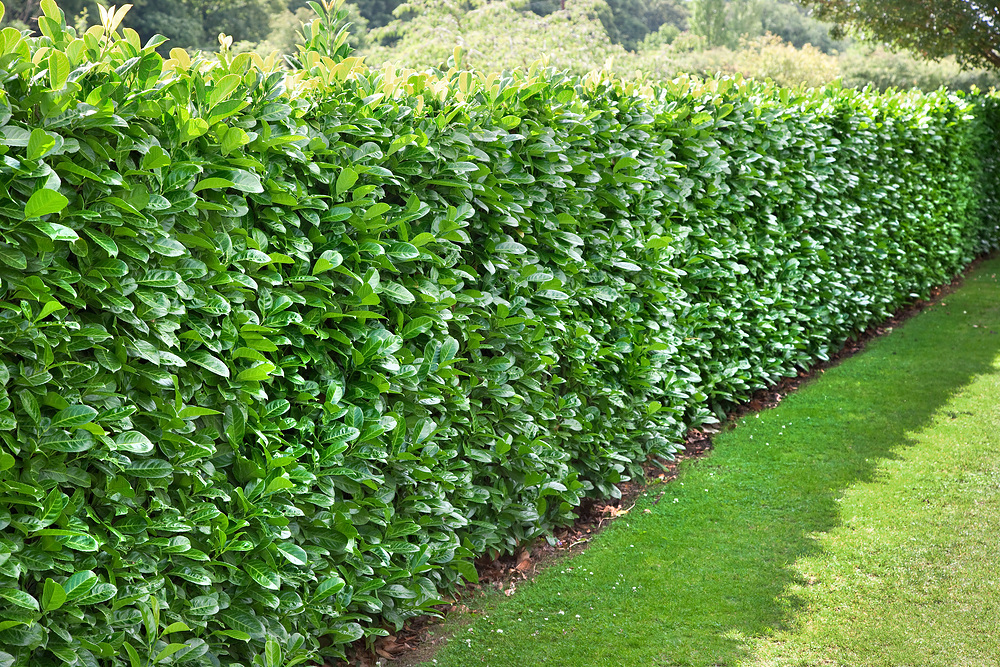
How fast and tall does laurel grow? The direct answer
Once established, cherry laurel (Prunus laurocerasus) commonly puts on 30 to 60cm of growth a year, while Portuguese laurel (Prunus lusitanica) typically manages around 20 to 45cm. Cherry laurel can eventually exceed 8 metres if left unpruned, while Portuguese laurel often reaches around 6 metres or more in favourable conditions. Most garden hedges are maintained at 1.5 to 3 metres, where regular trimming keeps the branches dense and the top within manageable reach.
Growth varies with soil, sunlight, moisture and root establishment. Laurel planted in reasonably fertile, well-drained soil with adequate water usually grows faster than plants struggling in dry shade or poorly drained clay. Both species retain their leaves through winter, but young plants still need regular watering during prolonged dry spells, particularly in their first growing season.
| Feature | Cherry laurel | Portuguese laurel |
|---|---|---|
| Growth per year | 30 to 60cm | 20 to 45cm |
| Untrimmed height | Over 8 metres | Around 6 metres |
| Typical hedge height | 1.5 to 3 metres | 1.5 to 3 metres |
| Leaf | Large, glossy, bright green | Smaller, darker, more pointed |
| Best for | Fast privacy, larger gardens | Tighter spaces, formal hedges |
Growth per year: cherry laurel versus Portuguese laurel
When gardeners ask how fast laurel grows, they are usually thinking about cherry laurel because it is the speedier of the two. In a good year, with plenty of moisture and a spring feed, you can easily see 60cm of fresh, pale green shoots. Portuguese laurel is a steadier grower, putting on 20 to 45cm annually, and its stems and leaves are denser from the start, which makes it a favourite for formal shapes.
Both types may grow slowly in their first season while new roots establish. Around 15 to 30cm of top growth is possible, although some plants produce less, particularly after a dry spring or summer. Growth often improves in subsequent years as the root system develops. Cherry laurel is generally the quicker choice for a tall boundary hedge, while the more restrained, compact growth of Portuguese laurel suits narrower spaces and formal trimming.
How tall a laurel hedge can get and the sensible height to aim for
An unpruned cherry laurel will eventually turn into a small tree, easily reaching 8 metres or more. Portuguese laurel is a little shorter, topping out around 6 metres. That sounds impressive, but for most gardens a hedge that tall is a problem: it blocks light from your own plot, can annoy neighbours and becomes a real chore to trim safely.
The sensible range for a garden hedge is 1.5 to 3 metres. At 1.8 to 2 metres, you get solid privacy at eye level without needing a ladder for the annual trim. If your garden is a small town plot or a new-build with close neighbours, keeping the hedge at 1.5 to 1.8 metres strikes a good balance between screening and light. For a large family garden where you want to block a view from an upstairs window, 2.5 to 3 metres works well, but do check any covenant or local height restrictions before you let it climb.
You control the final height entirely by pruning. Laurel responds well to hard cutting, so even if you inherit an overgrown hedge, you can bring it back down to size over a couple of seasons.
Which size to buy for privacy in year one
For screening sooner, start with the taller cherry laurel option: 90 to 120cm plants supplied individually in 2 litre pots. These provide useful height at planting, though gaps between the plants will remain until side branches develop. The 60 to 90cm plants, also supplied individually in 2 litre pots, give a lower starting hedge. Either size may put on noticeable growth during its first season, but the final height depends on establishment, weather and watering rather than following a fixed timetable.
The smaller 40 to 60cm cherry laurel plants in 9cm pots are another option for longer boundaries where immediate screening is less important. They need time to develop enough height and side growth to form a continuous hedge. Portuguese laurel is also available at 40 to 60cm in 9cm pots and 60 to 90cm in 2 litre pots, each as a single plant. Starting with the taller Portuguese laurel gives you more initial height, although it may still take several growing seasons to achieve a dense privacy screen.
Where space allows, a staggered double row can produce a thicker hedge with fewer visible gaps than a single row. The plants have branches growing into the spaces between neighbouring stems, but the time taken to form a solid screen still depends on spacing, initial plant size and growing conditions.
| Cherry laurel size supplied | Approx. height by end of year one | Time to 1.8m screen (single row) |
|---|---|---|
| 40 to 60cm (9cm pot) | 60 to 90cm | 3 to 4 years |
| 60 to 90cm (2 litre pot) | 90 to 120cm | 2 to 3 years |
| 90 to 120cm (2 litre pot) | 120 to 150cm | 1 to 2 years |
How to make laurel grow faster: Rootgrow, watering and feeding
Laurel is not a fussy plant, but a few simple steps will push the growth rate towards the top of its range. The most important thing you can do happens at planting time: add mycorrhizal fungi, such as RHS Rootgrow, directly onto the roots. Mycorrhizal fungi can form beneficial associations with plant roots and may support nutrient uptake where suitable fungi are not already established. Results vary with soil conditions, so Rootgrow should be treated as an optional planting aid rather than a reliable way to guarantee faster growth.
After planting, water deeply and regularly. A good soaking once a week in dry spells is far better than a daily splash, because it encourages roots to go down rather than hang around at the surface. In the first summer, do not let the rootball dry out completely. A 5cm mulch of bark or compost around the base (keeping it clear of the stem) locks in moisture and keeps weeds down.
Feeding is simple. In March or April, scatter a handful of general-purpose granular fertiliser, such as fish, blood and bone, around each plant and water it in. A second light feed in June can keep the flush of new growth going. Avoid high-nitrogen lawn feeds, which can produce soft, sappy shoots that are prone to frost damage. On poor sandy or chalky soils, an annual mulch of well-rotted manure in autumn does wonders for the following year's growth.
- Sprinkle RHS Rootgrow onto the roots at planting time.
- Water deeply once a week in dry weather for the first two summers.
- Apply a 5cm mulch of bark or compost to keep moisture in.
- Feed with fish, blood and bone in March or April and again lightly in June.
- On poor soil, add a mulch of well-rotted manure each autumn.
Spacing and its effect on how quickly your hedge fills out
Spacing affects how quickly individual laurel plants meet and develop a continuous hedge. For a single row, set cherry laurel around 60cm apart. At this spacing, the branches can begin to overlap over the following growing seasons, although the time needed for full screening varies. Where there is sufficient width, a staggered double row with 75cm between plants in each row and 60cm between rows can create a thicker boundary. It will also require more plants and take up more garden space.
Portuguese laurel, being naturally denser, can be spaced at 50 to 60cm in a single row. A double row is rarely needed unless you want an extra-wide hedge for sound reduction or a very formal look. Wider spacing, say 90cm to 1 metre, saves money but adds a year or more to the fill time, and you may end up with gaps that take several seasons to close.
For a typical 10-metre boundary, a single row of cherry laurel at 60cm spacing needs 17 plants. A double staggered row for the same length needs about 28 plants. The table below gives a quick reckoner for the most common hedge lengths.
| Hedge length | Single row (60cm spacing) | Double row (75cm, 60cm between rows) |
|---|---|---|
| 5 metres | 9 plants | 15 plants |
| 10 metres | 17 plants | 28 plants |
| 20 metres | 34 plants | 56 plants |
Month-by-month laurel care calendar
Keeping a laurel hedge growing strongly is mostly about doing the right thing at the right time. The calendar below covers planting, feeding, watering and pruning for an established hedge. Bare root planting generally takes place during the dormant season, roughly November to March, but our cherry and Portuguese laurel hedging options are supplied in 9cm or 2 litre pots, depending on the size chosen. Pot-grown laurel can be planted whenever the ground is workable, provided new plants receive adequate water.
| Month | What to do |
|---|---|
| January | Plant pot-grown laurel if the ground is workable. Check ties and stakes after winter gales. |
| February | Finish any winter pruning of overgrown hedges. Prepare planting holes for spring. |
| March | Start planting in earnest as the soil warms. Apply fish, blood and bone feed. |
| April | Ideal planting month. Water new plants in well. Mulch after planting. |
| May | New growth appears. Keep young plants watered during dry spells. |
| June | Light summer feed if growth looks slow. Trim informal hedges lightly if needed. |
| July | Water deeply once a week in dry weather. Check for vine weevil notches on leaves. |
| August | Give the hedge its main summer trim if you want a neat shape. Avoid cutting in hot sun. |
| September | Planting is still fine while the soil is warm. Reduce watering as growth slows. |
| October | Good month for planting. Clear fallen leaves from the base to prevent rot. |
| November | Bare root planting season begins. Apply an autumn mulch of well-rotted manure. |
| December | Plant pot-grown laurel in mild spells. Avoid walking on frozen or waterlogged soil. |
Common questions
How fast does cherry laurel grow compared with Portuguese laurel?
Cherry laurel grows faster, typically 30 to 60cm per year once established. Portuguese laurel manages 20 to 45cm annually. Both are slower in the first year while the roots settle, often putting on only 15 to 30cm. Cherry laurel is the better choice if you want a tall screen quickly, while Portuguese laurel's steadier, denser growth suits formal hedges that need less frequent trimming.
How tall will a laurel hedge grow if I never cut it?
An unpruned cherry laurel can eventually reach over 8 metres, and Portuguese laurel around 6 metres. In a garden setting, letting a hedge get that tall is rarely practical: it shades neighbouring plots, becomes difficult to trim safely and may breach local height restrictions. Most gardeners keep laurel hedges between 1.5 and 3 metres, which gives good privacy without becoming a burden.
How can I make my laurel hedge grow faster?
Start by adding mycorrhizal fungi such as RHS Rootgrow to the roots at planting time. Water deeply once a week in dry weather for the first two summers, and spread a 5cm mulch to lock in moisture. Feed with fish, blood and bone in March or April, and again lightly in June. On poor soil, an autumn mulch of well-rotted manure makes a noticeable difference the following spring.
What is the best spacing for a laurel hedge to fill in quickly?
For cherry laurel, space plants 60cm apart in a single row. This gives a solid hedge within two to three growing seasons. For even faster fill, plant a double staggered row with 75cm between plants and 60cm between the rows; this can save roughly a year. Portuguese laurel can be spaced at 50 to 60cm in a single row because it is naturally bushier.
Does laurel grow in shade?
Yes, both cherry and Portuguese laurel are remarkably shade-tolerant. They will grow under the canopy of larger trees or on a north-facing boundary, though the growth rate will be slower than in sun or partial shade. In deep shade, expect growth towards the lower end of the range, perhaps 20 to 30cm per year for cherry laurel. The leaves may also be slightly larger and darker as the plant reaches for light.
When is the best time to plant laurel for fast establishment?
Pot-grown laurel can be planted at any time of year, but early autumn (September to October) or mid-spring (March to April) give the best results. The soil is warm and moist, which encourages roots to spread quickly. Planting in high summer is fine as long as you keep on top of watering. Avoid planting when the ground is frozen solid or waterlogged.